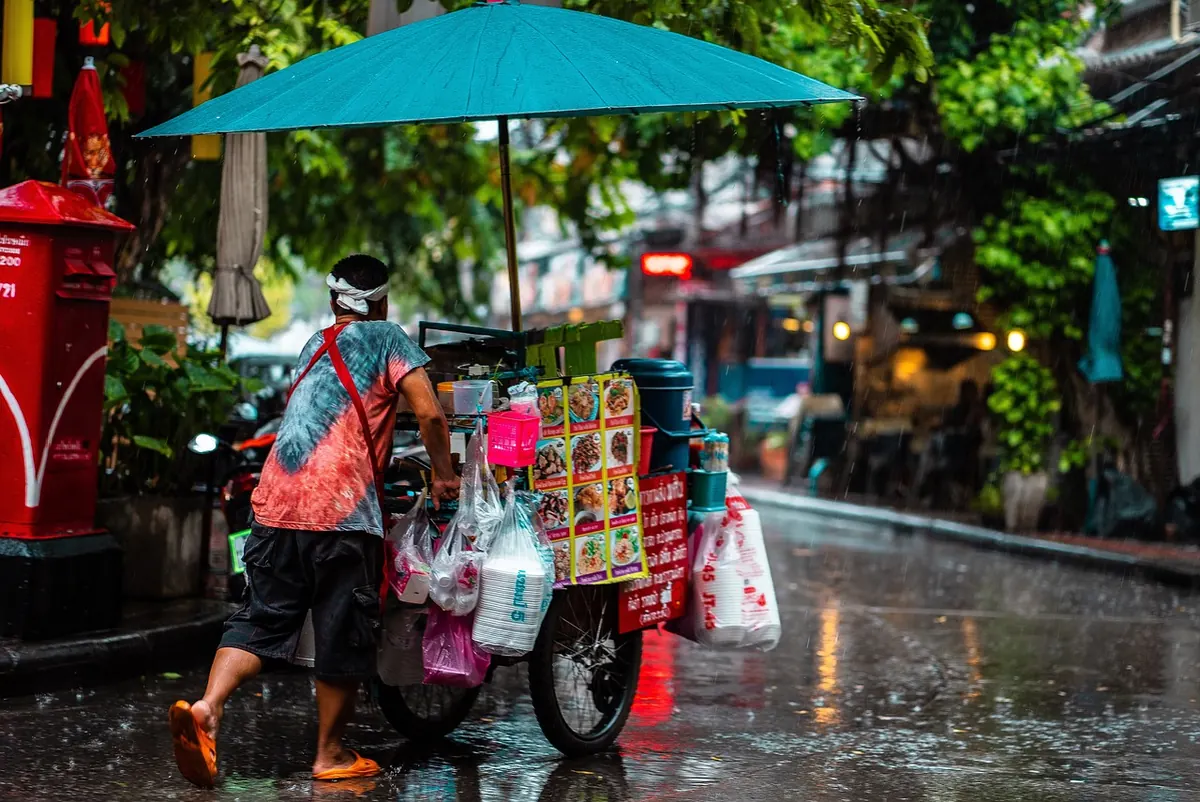
Ask five digital nomads where to base themselves in July and you'll get five different answers, all of them defensible. That's because South-East Asia doesn't have one monsoon. It has two, moving in opposite directions, and which one matters depends entirely on the coast you're standing on. Get the timing right and you can work through the wet months with an umbrella and a cheap monthly rent. Get it wrong and you'll spend three weeks watching cloudbursts from a café with unreliable Wi-Fi.
The good news is that the pattern is remarkably predictable. Once you know which system is overhead, you can plan a whole year of bases without ever really being rained out — and often at half the price the dry-season crowd is paying.
How South-East Asia's Two Monsoons Work
From roughly May to October, the south-west monsoon drags moist air across the Indian Ocean and drops it on Thailand, Laos, Cambodia, Myanmar, most of Vietnam and the western Philippines. From November to March, the north-east monsoon swings round and soaks a different set of places: Vietnam's central coast, the Gulf of Thailand islands, Malaysia's east coast and much of Indonesia.
Two things follow from that. First, "monsoon season" is a regional label, not a local forecast — Phuket and Koh Samui sit barely a short flight apart and have their wettest months six months apart. Second, tropical rain rarely means all-day drizzle. It means heavy showers, often in the afternoon or overnight, with long bright gaps between them. Plenty of people work straight through it.
It also means the region is always dry somewhere. That single fact is what makes a year-round itinerary possible.
Think in coasts, not countries. The same week can be a washout in Hoi An and flawless in Krabi.
November to February: Dry Season, With Exceptions
These are the months most of us picture when we book a ticket, and for good reason. Bangkok, Chiang Mai, Siem Reap, Luang Prabang, Ho Chi Minh City and the Andaman coast — Phuket, Krabi, Koh Lanta — are all at their best. Bali is dry, and Penang and Kuala Lumpur are workable, if prone to the occasional heavy afternoon shower.
The exceptions matter more than the rule. Vietnam's central coast, including Da Nang, Hoi An and Hue, is at its wettest from October into December, and flooding in low-lying areas is a genuine risk — Hoi An's old town has been known to take on water for days at a time. The Gulf islands of Koh Samui, Koh Phangan and Koh Tao collect their heaviest rain from roughly October to December. Malaysia's east-coast islands, the Perhentians and Tioman among them, largely shut down for the season, with ferries suspended and many resorts closed outright. The eastern Philippines can still catch late typhoons.
Prices peak around Christmas and New Year, so book accommodation and internal flights early. City Wi-Fi is generally fast and stable; on smaller islands, treat a working connection as a bonus rather than a tool.
March and April: The Shoulder Season Sweet Spot
March and April are hot, dry and comparatively cheap, with one significant caveat. In northern Thailand and Laos this is the burning season, when agricultural fires and trapped smoke push air quality to genuinely unhealthy levels in places like Chiang Mai. If you're sensitive to smoke, base yourself on the coast or in the south, and check live air quality readings before committing to a month.
Elsewhere it's a strong window. Vietnam's central coast is dry and sunny from roughly February to August, which makes Da Nang one of the most comfortable working cities in the region. The Andaman coast stays dry until late April. Bali is drying out and still affordable before the June rush.
Watch out for Songkran in mid-April. The Thai New Year water festival spills into Laos and Cambodia too, and for a few days transport is booked solid and plenty of businesses close — charming if you're on holiday, mildly disruptive if you have client calls.
May to October: The South-West Monsoon
This is the half of the year that scares people off, and it shouldn't. Rents drop by a third or more, coworking desks are easy to find, and the landscape turns a green you won't see in February. What you're trading is certainty: expect a solid downpour most afternoons, occasional multi-day grey spells, and the chance of a washed-out road or cancelled ferry.
Where it lands hardest:
- Thailand's Andaman coast — Phuket, Krabi and Koh Lanta take their heaviest rain from May to October, with September and October usually the wettest.
- Bangkok and Chiang Mai — wet from roughly June to October, but rarely all day. Bangkok's floods are more about drainage than rainfall volume.
- Vietnam — Hanoi and Ha Long Bay are wettest July to August; Ho Chi Minh City runs May to October with sharp, short downpours.
- Cambodia and Laos — Siem Reap, Phnom Penh and Luang Prabang are soaked June to October, though Angkor Wat in the rain, with the crowds gone, is one of the region's great experiences.
- Myanmar — monsoon from June to September; beach destinations like Ngapali close for much of it.
- The Philippines — Manila and much of Luzon are wet from June to November, with typhoon season peaking August to October.
And where to go instead: Bali, Lombok and Flores stay largely dry from May through September; so does Vietnam's central coast; so does peninsular Malaysia's west side, including Penang and Langkawi.
A Month-by-Month Cheat Sheet
- January–February: Almost everything works. Best overall window for the region.
- March: Hot and dry; avoid northern Thailand and Laos if smoke bothers you.
- April: Still good, but Songkran disrupts travel mid-month.
- May: The south-west monsoon arrives; head to Bali, Da Nang or Malaysia's west coast.
- June–August: Wet across Thailand, Laos, Cambodia and Vietnam; dry in Indonesia.
- September: Peak rain in Thailand and Vietnam; often a bargain month.
- October: Transition — Gulf islands and central Vietnam get hit; Andaman coast starts clearing.
- November–December: Dry season returns to most of the region; book early for the holidays.
Working Through the Rain: Practical Notes
A few habits make wet-season life far easier. Book accommodation with a desk and a generator or backup power, and ask directly about internet redundancy — a second provider or a mobile hotspot matters more than a fast headline speed. Keep everything in the cloud, and treat any day with a critical call as a day to work from a coworking space rather than a beach bungalow.
Rainy season is also dengue season, so repellent and long sleeves at dusk are worth the hassle. Roads flood quickly, so avoid long motorbike trips after heavy rain, and build a buffer day around any flight or ferry. Finally, embrace the rhythm: work in the morning, swim or sightsee around midday, and let the afternoon storm do its thing while you're at your desk.
Plan around the two monsoons rather than against them, and South-East Asia stops being a seasonal gamble. It becomes a year-long rotation of dry coasts, cheap rents and green hills — with the added bonus that you'll never again pay high-season prices for a room you barely use.
Photo: mxwegele / Pixabay